Why the 80,000 Word Limit Is a Myth
A response to traditional publishing's obsession with word count
So recently, I found myself flicking through TikTok. People have often told me I should get involved with “BookTok,” but if I’m honest, I never really understood it. It just seems to be the same handful of books being hyped by different people, all saying more or less the same thing. That’s never really appealed to me, so I gave it a miss.
That said, I do find it interesting to hear what others are experiencing, and occasionally, I come across posts from supposed “industry experts” worth listening to. That’s what this post is about.
I recently stumbled across videos from a literary agent. I won’t name names. At first, I thought she might be interesting to follow. While I’m not traditionally published, as an indie author, I’m always curious to hear insights from the other side of the fence.
One of her videos was about word count. She claimed that, without exception, no novel should ever exceed 80,000 words. She even implied that anything longer was inherently inferior.
Now, I understand the constraints of traditional publishing: print costs, shipping, shelf space, returns. Even translation costs were cited. But when she mentioned the cost of translating longer books, I had to raise an eyebrow. If a book is in demand enough to justify translating it, then surely there's already a market, so that cost is kind of irrelevant.
Still, I accepted those as traditional publishing limitations. What I really wanted to know was: is there a literary reason for the 80,000-word limit?
I asked her that question five times. Not aggressively, just genuinely curious. But she never answered. The first time, she claimed she didn’t see my question because it was hidden behind a “more” button. After that, she just got increasingly defensive and eventually downright rude.
Finally, she decided to attack me personally. She saw on my TikTok (where I’ve only ever posted about 10 times) that I’d animated my book cover using AI so I could add music and overlay text for a short promo video. Because of that, she accused me of being an “AI Slop” creator. According to her, if I used AI in a video, then my entire body of work must be AI-generated garbage.
At that point, I stopped replying. Honestly, I regret that now, because it probably looked like she “won.” But it just wasn't worth my energy. And sure enough, she blocked me.
Later, when I was down with a flu bug, I did a bit of research. I found her agency’s website. It looked very polished and professional, but it focuses mainly on children’s and YA fiction, which isn’t my genre. Still, I looked up about 40 of the authors she represents and checked their rankings on Amazon.
With one exception, every single one ranked below 250,000 in the Kindle store. Many were over 1.2 million. Some even lower.
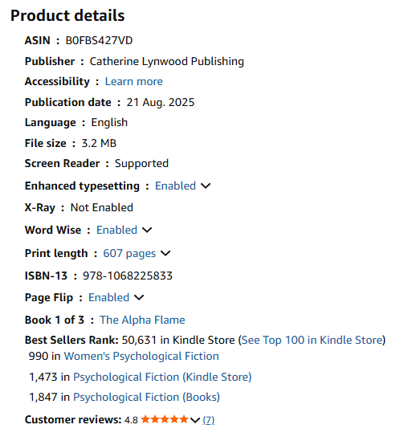
Compare that to my own self-published, indie book of 155,000 words, created on a shoestring budget, currently ranking at 50,631.
So, was she right about the 80,000-word limit?
I don’t think so.
Recently, a kind book fairy left a copy of my book in a café in the town where the story is set. A lady called Natalie picked it up. She read the entire thing in two days.
Natalie Ravenscroft:
Catherine Lynwood I read it in 2 days. I couldn't put it down. It was really a great book. I’m going to purchase it and the next one, and any others you do. You are a great author. xx
That one comment says everything I need to know.
To me, this obsession with a word count limit says more about the constraints of traditional publishing, and the people running it, than it does about the needs of actual readers. I think readers like Natalie are tired of being told what to read by TikTok experts or how long a book should be. They just want stories they can connect with, get lost in, and be moved by, whether that takes 60,000 words or 160,000.
Let’s be honest: traditional publishing limitations aren’t about story. They’re about money.
And they’re also out of touch.
Kindle reading is on the rise. Audiobooks are more popular than ever. I love audiobooks. And when I buy one, the last thing I want is for it to be over in 30 minutes, especially if I paid the same as I would for a longer title. I’ve listened to every Agatha Christie novel, and the only time I felt cheated was when I bought a short story collection thinking it was a full-length book.
So here’s my advice to fellow indie authors: stop worrying about word count.
Yes, edit your work. In my latest book, I’m only a quarter of the way through my first full edit and I’ve already cut over 40 pages. But I’m doing that for the story, not to hit some arbitrary size. I want my book to be however long it needs to be to stay interesting from beginning to end, and leave readers wanting more.
That’s the only rule that should matter.